In the gas vs. pellet vs. kamado grill decision, the right choice comes down to how you cook. Gas heats in about 15 minutes and is easiest for weeknights. A pellet grill typically holds about 180 to 500°F for hands-off smoking but needs power and dry pellets. A ceramic kamado runs about 200 to 750°F on lump charcoal and does it all, with a learning curve.
Key takeaways
- Gas: fastest and easiest; add an infrared burner for a steakhouse sear.
- Pellet: set-and-forget wood smoke; needs a 110-120V outlet and dry pellets.
- Kamado: widest range and boldest flavor, but more hands-on.
- Hybrid: gas, charcoal or hardwood in one grill.
- Under a lanai roof, follow your manual and local code: some grills need a rated vent hood, and others cannot go under a combustible roof at all.
In this guide
- Gas vs. pellet vs. kamado: side-by-side comparison
- How do gas, pellet and kamado grills work?
- Gas grills: infrared searing and natural gas vs. propane
- Pellet grills in Florida: power, humidity and storm season
- Kamado grills: ceramic heat retention and lump charcoal
- Hybrid grills and premium built-in brands
- Built-in vs. freestanding grills: what changes the install
- Quick decision guide: which grill should you buy?
- Frequently asked questions
Gas vs. pellet vs. kamado: side-by-side comparison
The jobs in this guide are our own: Grill & Hearth has been family-run since 1997. Here is how the grills and smokers we sell, install and service compare.
| Feature | Gas (incl. infrared) | Pellet | Kamado |
|---|---|---|---|
| How it heats | Gas burners; infrared emitters on some | Auger-fed pellets, fan, digital controller | Lump charcoal, ceramic body, vents |
| Heat-up | About 15 min (Blaze); TEC infrared to 900°F in 10 min | Lid-open start-up until the heavy smoke clears (Pit Boss) | Natural starters, plus extra time to settle at low smoking heat |
| Temperature range | TEC 200 to 900°F; Alfresco Sear Zone to 1,500°F | 180 to 500°F (Pit Boss 700FB2); Flame Broiler to 1,000°F | 200 to 750°F (Big Green Egg Large) |
| Flavor | Clean; wood needs a smoker box or hybrid | Hardwood smoke, mild to moderate | Charcoal plus wood chunks, the strongest |
| Needs an outlet | Not to cook | Yes, 110-120V | No |
| Upkeep | Grease tray, burn-off, burner tubes, stainless care | Empty hopper, clear ash, keep pellets dry | Ash removal, gasket and hardware care |
| Florida watch-outs | Salt air; insects in burner tubes; roof rules vary | Humid pellets swell; outages stop it; no combustible roof | Heavy to move; clearances and air gap when built in |
| Best for | Weeknights, searing, outdoor kitchens | Low-and-slow smoking | Smoking, searing and pizza in one |
Flavor, versatility and the best grill for beginners
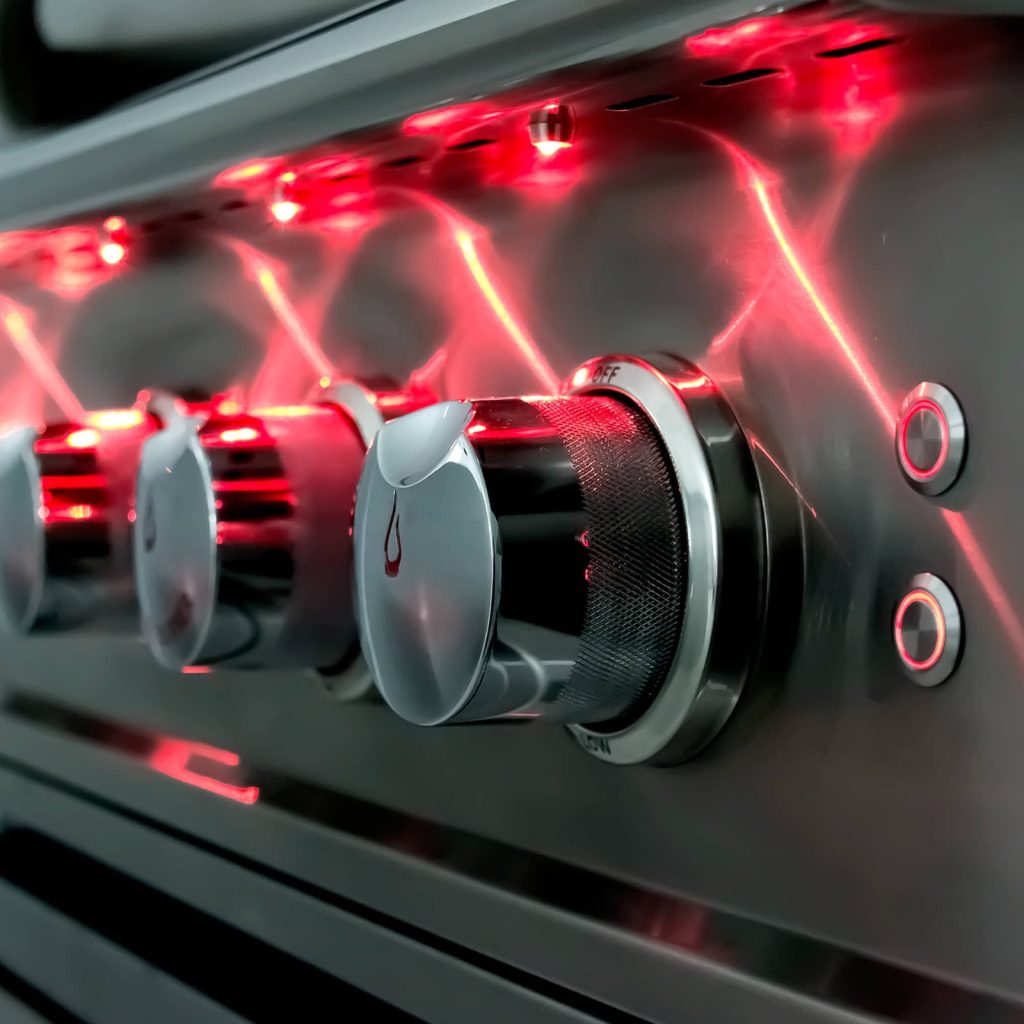
Pellets give mild to moderate hardwood smoke; gas tastes clean. A kamado adds the boldest charcoal flavor and the widest range: smoke, roast, bake, sear and pizza. For beginners, gas is easiest, a pellet grill is close behind for smoking, and a kamado rewards practice.
How do gas, pellet and kamado grills work?
Gas grills: burners and instant control
A gas grill burns propane or natural gas in burners under the grates, and the knob changes the heat instantly. Blaze says to preheat on high with the hood closed for about 15 minutes.
Pellet grills: an auger, a fan and a thermostat
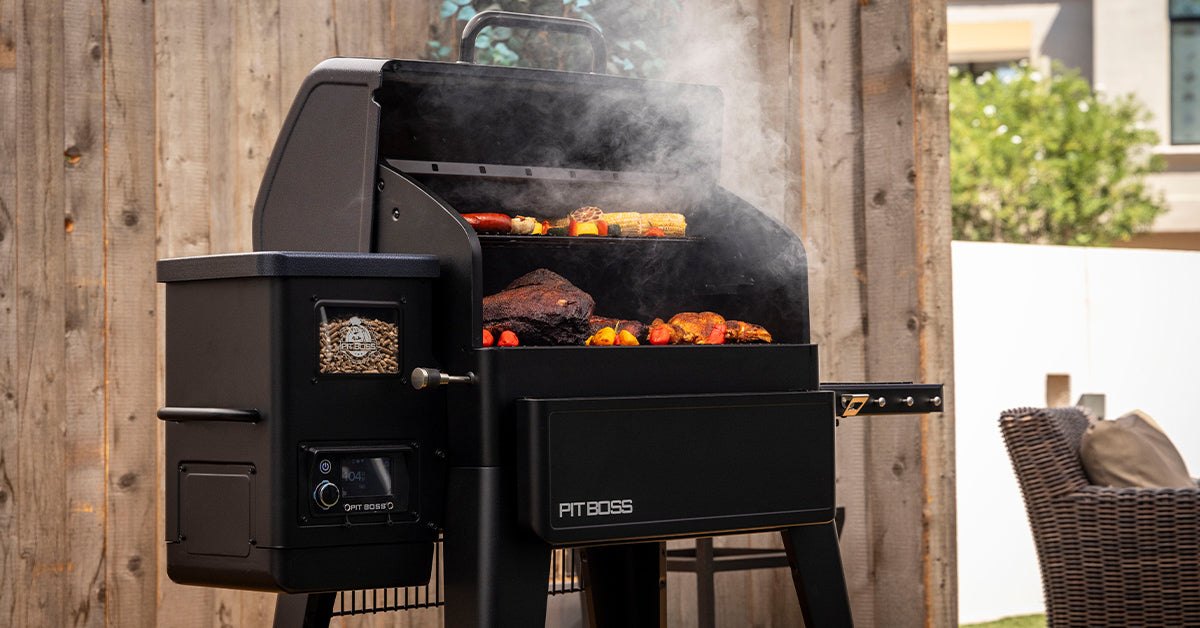
A pellet grill is a wood-fired grill and smoker that burns compressed hardwood pellets. An electric auger feeds them from a hopper to a firepot, where an igniter and a fan keep them burning while a digital controller holds your temperature. Pit Boss rates its 700FB2 from 180 to 500°F, with a Flame Broiler lever for direct-flame searing up to 1,000°F.
Kamado grills: lump charcoal in a ceramic shell
A kamado is a thick ceramic cooker that burns natural lump charcoal. Top and bottom vents set the airflow, and airflow sets the temperature. The ceramic holds heat, so a kamado can smoke low for hours or climb to pizza and searing heat; Big Green Egg rates its Large EGG for 200 to 750°F. Ceramic cools slowly, so approach your target temperature gradually.
Gas grills: infrared searing and natural gas vs. propane
How infrared burners sear
An infrared burner uses the flame to heat a ceramic, glass or metal emitter that radiates intense heat to the food for a fast, hard crust. TEC builds its all-infrared grills around it and rates its 44-inch Sterling Patio FR from 200 to 900°F, reaching 900°F in 10 minutes. Alfresco says its Sear Zone burner hits 1,500°F in four minutes.
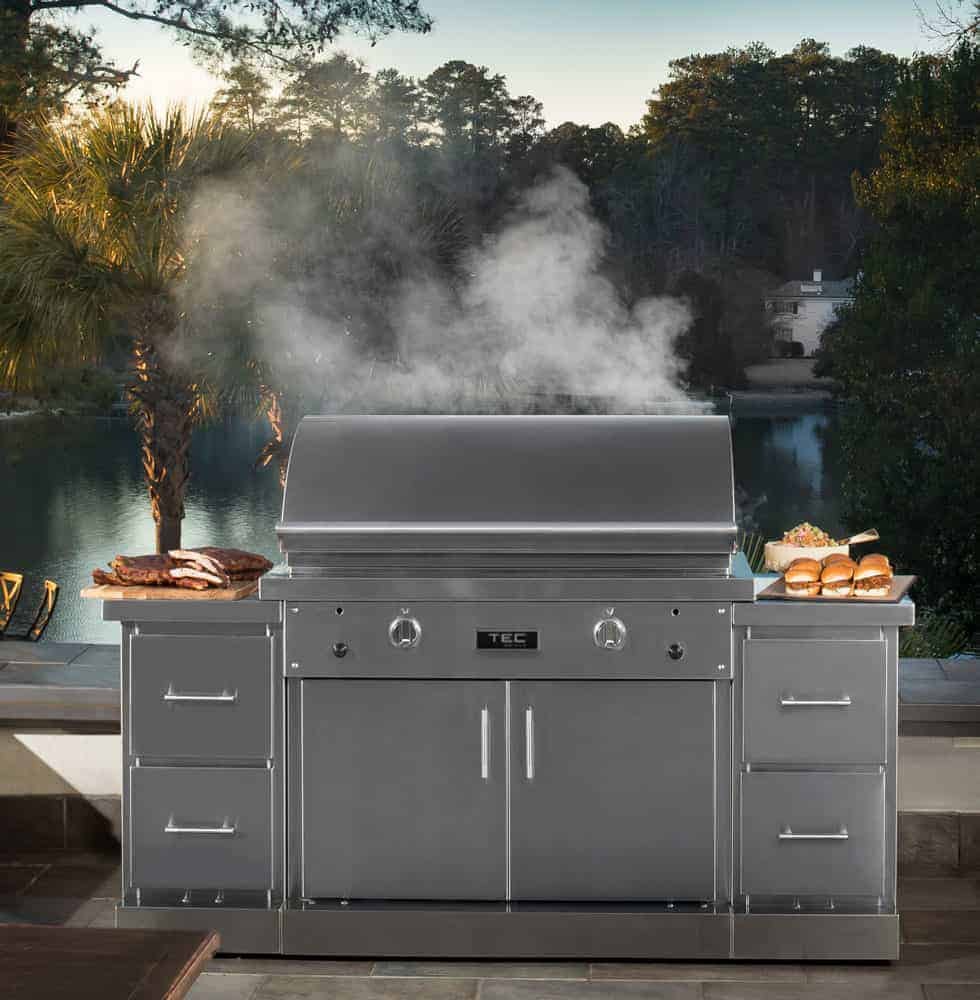
The trade-off: Solaire’s maker says its infrared burner does not turn down as low as a conventional one, so many cooks pair one infrared burner with conventional burners. Blaze says to run its infrared burner on high, hood open, for 5 to 7 minutes after each cook, and Solaire’s maker says to keep water off a cold ceramic plate, so keep it covered between cooks.
Natural gas or propane grill?
Natural gas means no tank swaps but needs a line run to the grill; a propane tank lets a freestanding grill sit almost anywhere. Many homes here lack gas service, so we offer propane tank refills at our Palm Coast showroom.
Fuel cost depends on local rates and how often you cook. Per the EIA, a therm (100,000 Btu), the unit gas utilities bill by, equals about 1.1 gallons of propane (91,452 Btu per gallon), so compare your therm price with 1.1 times your propane price per gallon.
Grills are ordered for one fuel or the other, and Blaze says only a licensed gas professional should convert one. In Florida, LP gas work is licensed under Florida Statutes s. 527.02, and natural gas piping falls to licensed plumbing contractors under Florida Statutes s. 489.105.
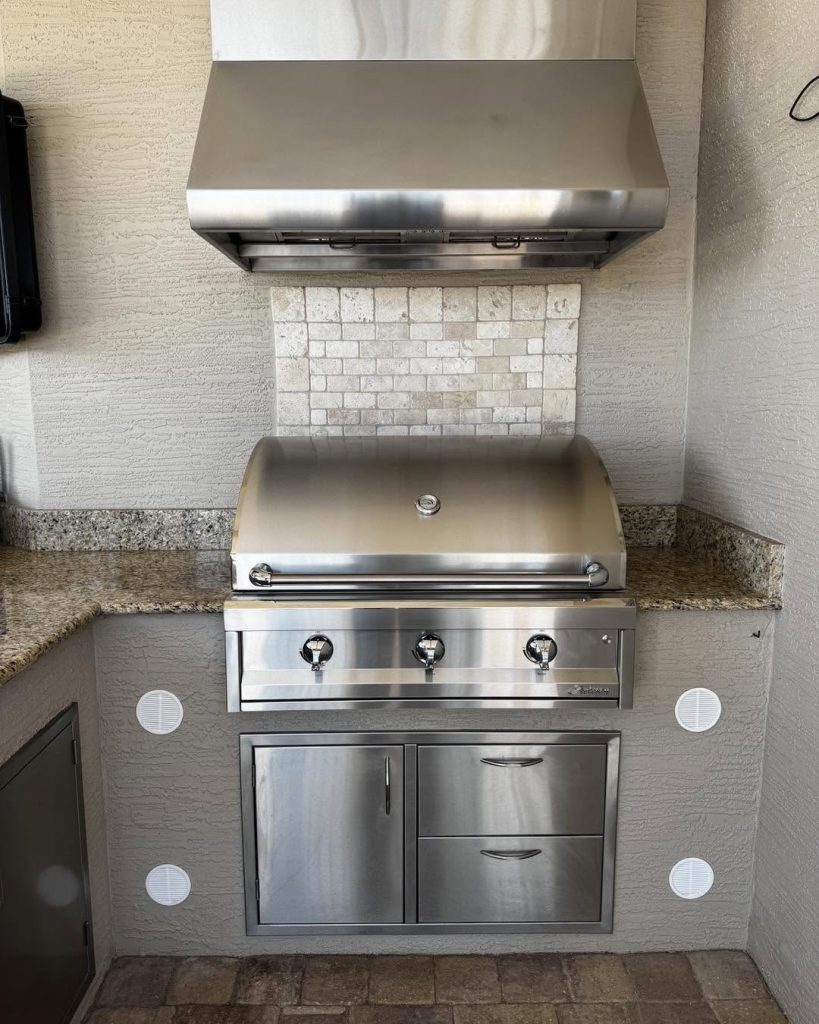
From our jobs: a Solaire infrared changeout and an Artisan 36-inch replacement
On one job, a Solaire grill with infrared burners replaced an aging built-in unit. On another, a new Artisan 36-inch built-in took the place of a worn-out American Outdoor Grill, with the island cut-out altered to fit. See our Solaire infrared changeout and Artisan 36-inch replacement.
Pellet grills in Florida: power, humidity and storm season
Plan for an outlet and power outages
Pit Boss pellet grills run on household power: Pit Boss lists a 110-120V supply for its 700FB2 and says to use a grounded outlet. Have an electrician add an outdoor-rated outlet near the grill rather than running a long extension cord.
The Atlantic hurricane season runs June 1 to November 30, per NOAA, and a pellet grill stops when the power does. A gas grill or kamado can still cook after a storm, but only outdoors: grill manuals warn against cooking in a garage, where carbon monoxide builds up.
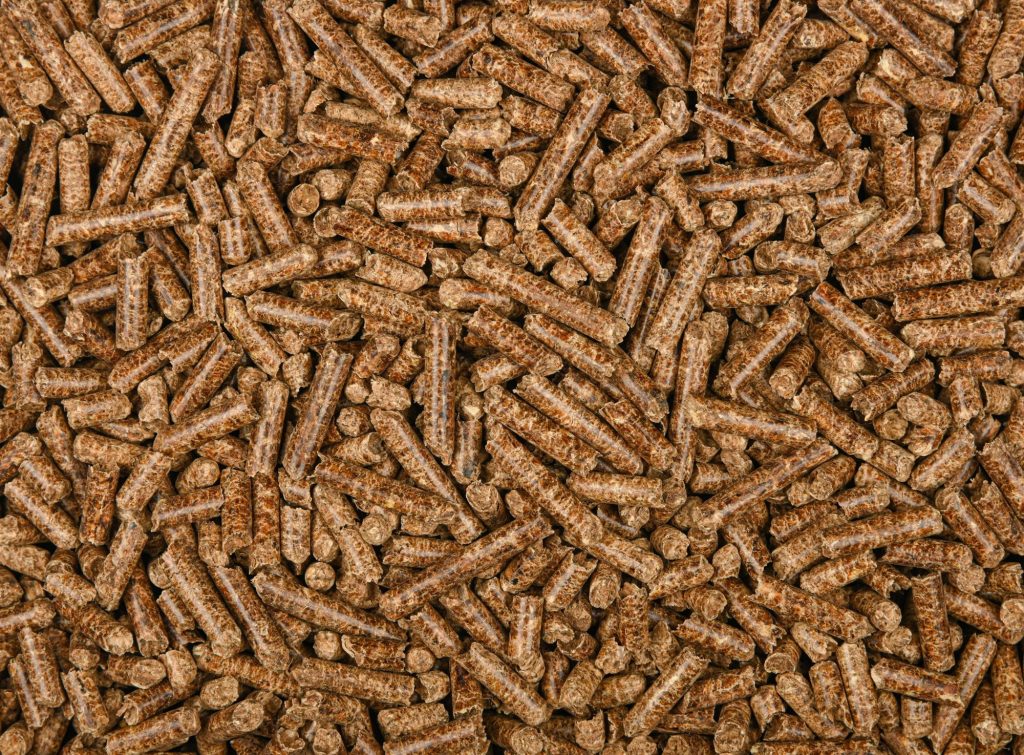
Keep pellets dry in Florida humidity
Pit Boss’s manual says hardwood pellets are highly susceptible to moisture: wet or humid pellets expand greatly, break down and may jam the feed system. Store them airtight, such as in a sealed 5-gallon bucket, indoors or in another dry spot, and empty the hopper and auger before long breaks.
Florida pellet checklist
Use the grill in the open: Pit Boss’s 700FB2 owner’s manual says it must not be placed under an overhead combustible ceiling or overhang and needs 36 inches from combustible construction at the sides and back. It also says not to cook in the rain, so wait out afternoon storms.
Kamado grills: ceramic heat retention and lump charcoal
Lump charcoal, not lighter fluid
Big Green Egg’s safety tips call for natural lump charcoal only, with no lighter fluid. Use natural fire starters, and “burp” a hot dome by lifting it a few inches before opening it fully, to prevent a flashback. Big Green Egg says flame spilling out of the EGG means it is running too hot.
Building a Big Green Egg into a counter
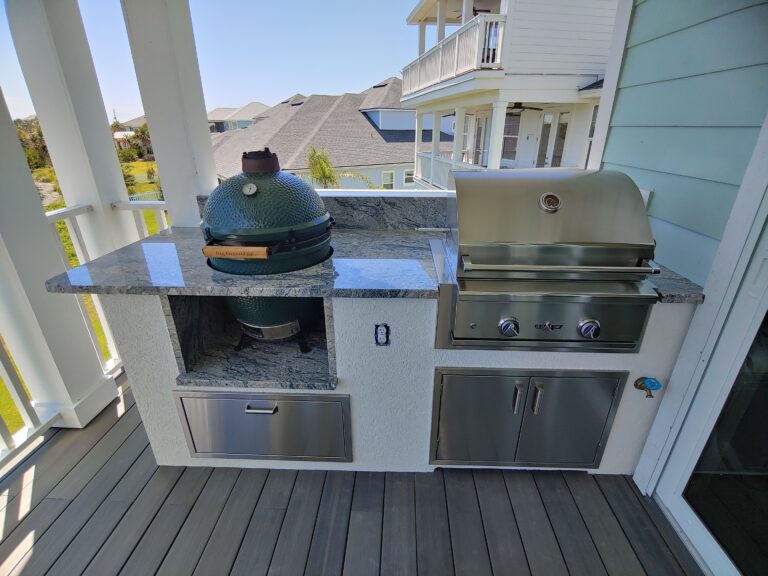
On one job, we set a Big Green Egg into a custom counter, which gives prep space on both sides and a clean, finished look. We carry Big Green Egg kamado grills, so ask us about built-in Egg installations.
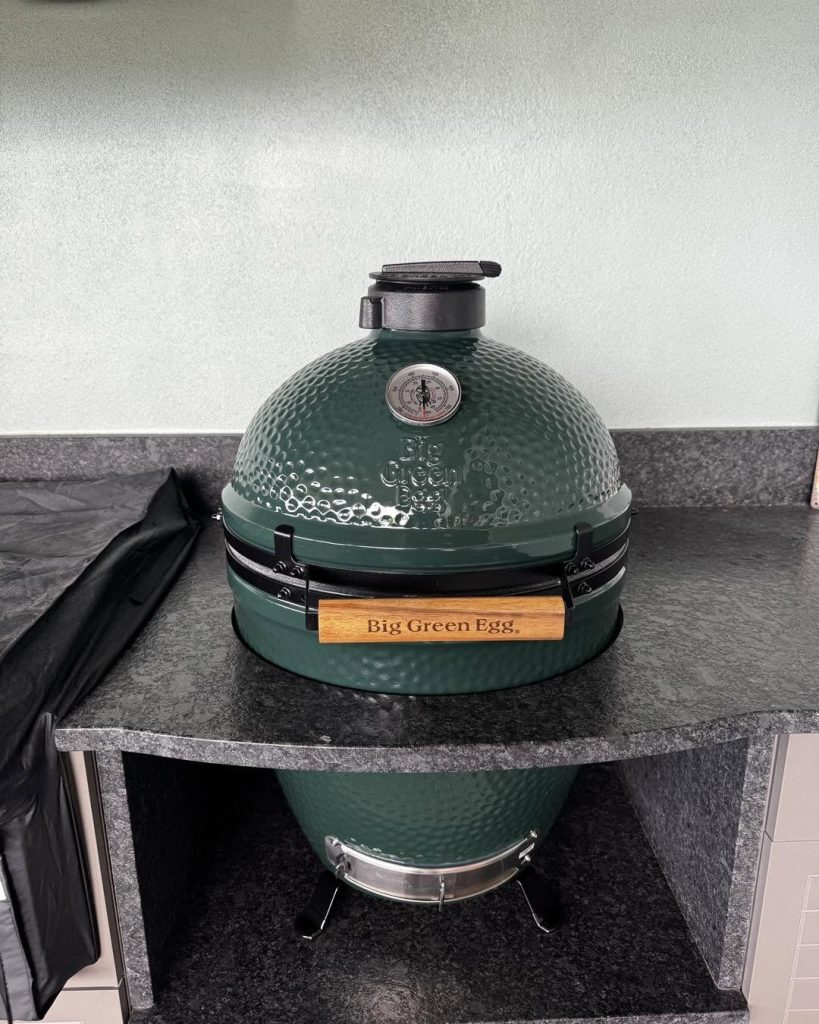
Big Green Egg also calls for an air gap around a built-in EGG, plus 14 inches from combustibles at the sides and back and 36 in front. Near the ocean, the ceramic will not rust, but the steel band and hinge can, so check that hardware and keep the EGG under a ventilated cover.
Hybrid grills and premium built-in brands
Hybrid grills: gas, charcoal and wood in one
A hybrid grill cooks on gas, charcoal or wood in one firebox. Among American Made Grills hybrids, the maker lists the Muscle 42 with a multi-fuel tray system, six burners, a rotisserie back burner and #304 stainless.
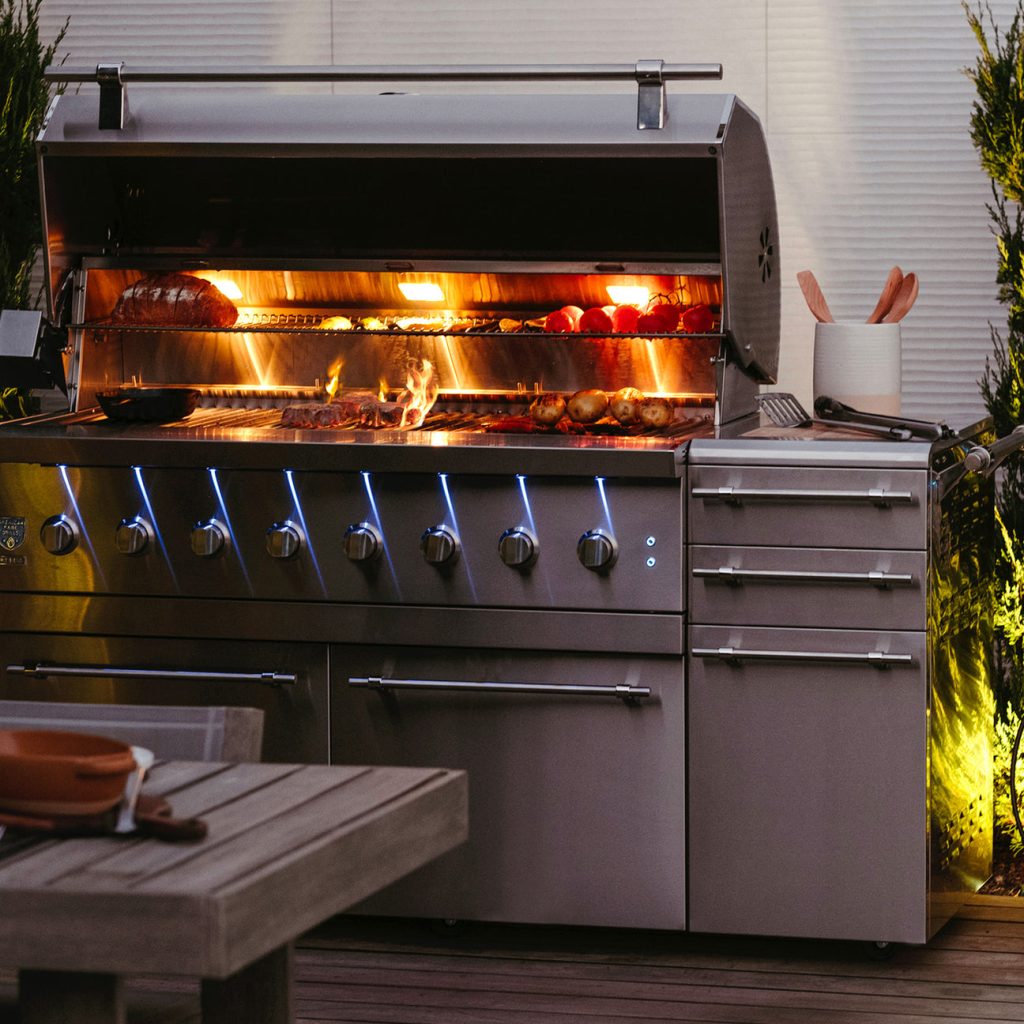
What sets premium built-in gas grills apart
- Stainless grade: most premium grills, including TEC, Alfresco and American Made Grills, use 304, which can tea-stain near the surf.
- Burner type: conventional, infrared or both.
- A rear rotisserie burner for spit-roasting.
- Size: about 24 to 48 inches wide.
- Fuel and service access: natural gas or propane, and room to reach the valves.
We carry grills across price tiers, from luxury Fire Magic, Twin Eagles and Alfresco built-ins to all-infrared TEC and Broilmaster post and cart grills; see all the grill brands we carry.
Built-in vs. freestanding grills: what changes the install
Built-in vs. freestanding grills
A built-in grill drops into an island with counters and storage. When the head wears out, it can be swapped while the island stays: we replaced a grill with a failing inner liner and upgraded another kitchen to a 48-inch grill by adjusting the island.
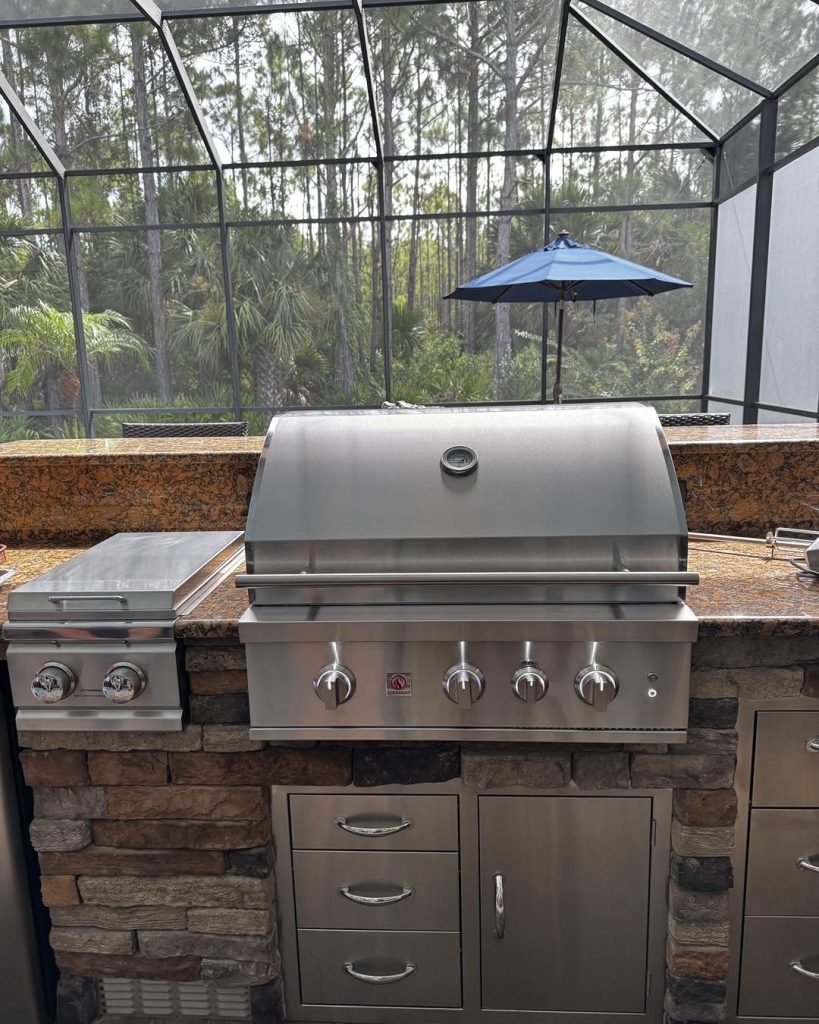
Blaze requires a non-combustible island, or an insulated jacket for a combustible one, plus 14 inches from combustibles at the sides and 16 at the back; other brands vary, so check your manual. Freestanding cart and post grills install simply and stow easily before a storm. For a new island, see outdoor kitchen design and installation.
Covered lanais and vent hoods
Blaze’s LTE2 manual says covered locations should be avoided; where its grill does go under combustible overhead construction, it requires a vent hood larger than the cooking area, rated 1,200 CFM or more, with at least 6 feet from countertop to ceiling. Others, like the Pit Boss above, must not go under a combustible roof at all. NFPA reports that about a quarter of home structure fires involving grills start on an exterior balcony or open porch.
Hoods wear out too: we have replaced an older Vent-A-Hood that had stopped working over a built-in grill.
Condo or apartment? Check the fire code first
In multifamily buildings, NFPA 1 section 10.10.6 of the Florida Fire Prevention Code, as quoted by the St. Johns County Fire Marshal, bars using or storing grills on balconies and using them under overhangs or within 10 feet of the building. Exceptions: listed electric tabletop grills up to 200 square inches, and listed equipment permanently installed per its listing; St. Johns County requires a building permit and an indoor listing, which rules out most outdoor-only grills. It also treats first-floor patios as balconies, so ask your fire marshal and association first.
Salt air and stainless steel
Tea staining, the brown film salt leaves on stainless, is cosmetic according to the Australian Stainless Steel Development Association (ASSDA), which says sheltered spots the rain never rinses, like a covered lanai, are most prone. Within about 3 miles of the surf, it treats grade 316 as the minimum and expects 304 to stain, so plan on a cover and regular washing.
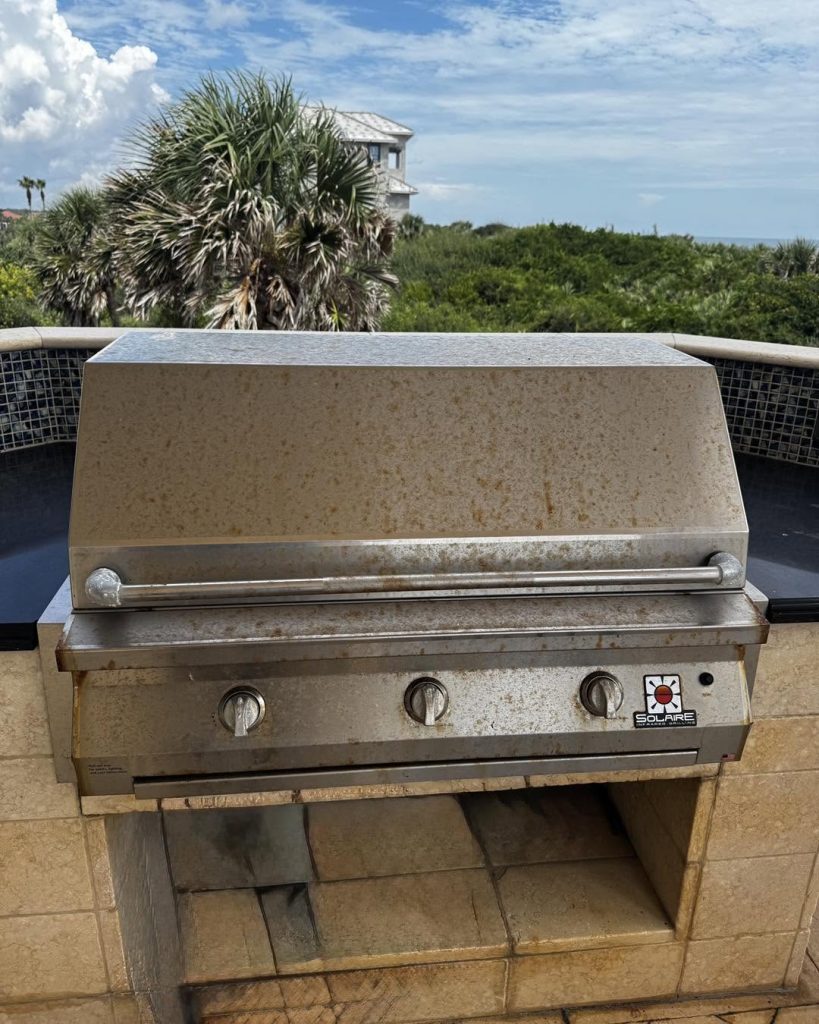
ASSDA recommends mild soap and warm water, then a rinse, and never bleach or chloride cleaners. Blaze also requires a wind break at consistently windy oceanfront sites, since wind blowing into the hood gap can overheat the control panel.
For oceanfront decks in Ponce Inlet and similar spots, see our guide to outdoor kitchen materials that hold up to salt air.
Quick decision guide: which grill should you buy?
Match the grill to how you cook
- Weeknight speed: gas, with an infrared sear burner if you love steaks.
- Set-and-forget smoking: pellet, if you have an outlet and dry storage.
- One cooker for everything: kamado.
- Gas convenience plus live fire: a hybrid.
- Condo or apartment: check the fire code; a listed electric tabletop grill may be the legal option.
Pairing a gas grill with a kamado in an outdoor kitchen
The gas grill handles fast meals and sides; the kamado smokes, bakes pizza and sears. Set the kamado into the counter beside the grill, as on our Big Green Egg job, with its clearances and air gap, and check both manuals before building under a roof. A blank-slate build, like one outdoor kitchen we finished, lets the island, gas line and hood come together.
Mistakes to avoid
- Choosing on Btu ratings alone.
- No outlet planned for a pellet grill, or pellets left in the hopper for weeks.
- Putting any grill under a lanai roof without checking its manual: some require a rated vent hood, others forbid a combustible roof overhead.
- Ignoring yellow flames or popping: insects nest in burner tubes, so check them at least yearly and as often as your manual says (Blaze: before each use; Alfresco: every 6 months).
- Lighter fluid in a kamado.
- DIY conversions between propane and natural gas.
- Skipping cleanup: NFPA links about 20% of home grill fires to grills that had not been cleaned.
- Cleaning stainless with bleach.
Frequently asked questions
Is a pellet grill better than a gas grill?
Neither wins outright. A pellet grill feeds hardwood pellets automatically to hold a set temperature, so it excels at hands-off smoking with real wood flavor. A gas grill heats faster, is simpler to run and sears better, especially with an infrared burner. Some households own both, or choose a hybrid.
Can you sear a steak on a pellet grill?
Yes, with limits. Most pellet controllers top out around 500°F, which browns a steak but rarely gives a deep crust. The Pit Boss Flame Broiler lever allows direct-flame searing up to 1,000°F. For frequent searing, an infrared gas burner (Alfresco’s Sear Zone reaches 1,500°F) or a kamado at high heat works better.
Do pellet grills need electricity?
Yes. The igniter, auger, fan and controller all run on household current, and Pit Boss lists a 110-120V supply for its 700FB2. Plan a grounded, outdoor-rated outlet near the grill. A pellet grill will not run during a power outage, so a gas grill or kamado makes a useful backup, used outdoors only.
What type of grill is best for beginners?
Gas is the easiest start: push-button ignition, about 15 minutes to preheat and instant heat control. A pellet grill is a close second for smoked food, because the controller manages the fire. A kamado has the steepest learning curve, but it rewards practice with the widest range: 200 to 750°F on a Big Green Egg Large.
Can I convert a propane grill to natural gas?
Often, but not yourself. Switching requires the manufacturer’s conversion parts installed by a licensed gas professional, as Blaze’s manual specifies, and some models cannot be converted. In Florida, LP gas work is licensed under Florida Statutes s. 527.02, and natural gas piping falls to licensed plumbing contractors under s. 489.105.
Is a kamado or a pellet grill better for smoking?
Both smoke well. A pellet grill is easier: its controller feeds pellets to hold your set temperature, so you can walk away, but it needs power and dry pellets. A kamado holds low heat for hours on lump charcoal, gives a stronger charcoal-and-wood flavor and also sears and bakes pizza, but you manage the vents.
Plan it with a local pro
Bring photos and measurements of your patio or lanai to our showroom at 4982 Palm Coast Pkwy NW, Suite 7 (Monday to Saturday, 9 to 5), and our family-run team will help you match the grill to your space, your fuel and the way you cook. We sell, install and service grills, outdoor kitchens and fire features across Flagler, Volusia and St. Johns Counties.